
Employee review meetings
A complete guide to supporting talent throughout the employee journey.
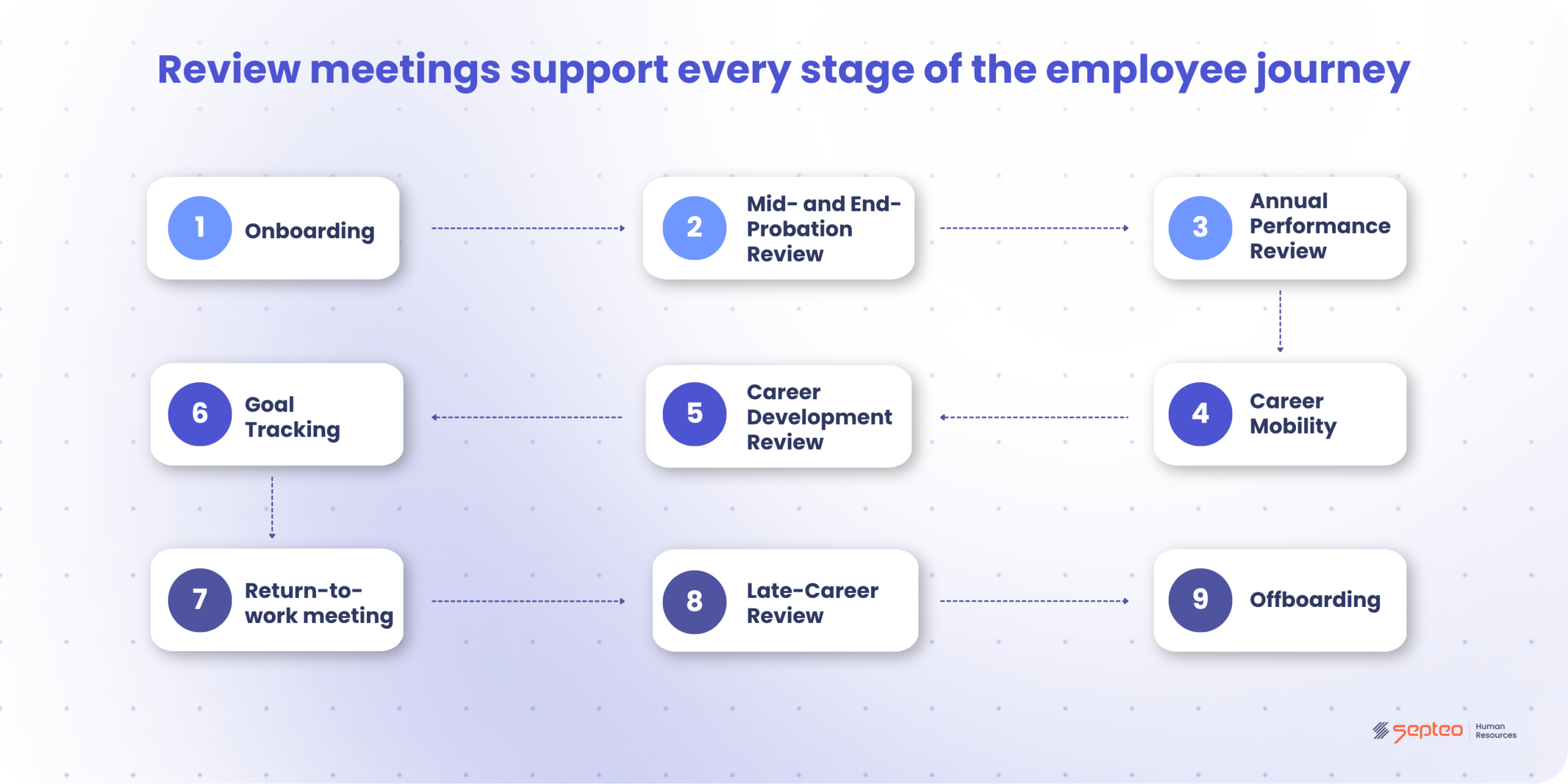
Employee review meetings take place throughout an employee’s time with an organisation. They support onboarding, help review performance, clarify career prospects and monitor skills development. They can also prepare an internal move, support a return after a long absence or facilitate a career transition.
The term covers several HR and management conversations, each with a specific purpose. A performance review differs from a career development conversation or an exit interview. Combining them all can lead to overly long forms and discussions that rarely translate into concrete action.
For HR teams, the challenge is to schedule the right conversation at the right time and collect information that can be acted on. This guide explains how to integrate these conversations into a coherent talent management strategy.
What is an employee review meeting?
In a broad sense, an employee review meeting is a structured discussion between an employee and their manager or an HR representative. It serves a clear purpose: reviewing work, setting objectives, preparing development, identifying learning needs or supporting the employee journey.
The employee journey is punctuated by several conversations, from onboarding to departure. Their format and frequency may vary according to local practices, collective agreements and company policies. Across Europe, organisations should define a clear purpose, ensure fair and consistent processes, and adapt each conversation to the employee’s situation.
Why organise different types of employee review meetings?
Separating these conversations avoids bringing performance, learning, mobility, workload and pay into one single framework.
A clear purpose makes discussions more effective and helps HR teams trigger the right actions.
Distinct conversations can help organisations:
- monitor skills development
- identify learning needs
- support internal mobility
- detect difficulties and support needs
- make more reliable career decisions
- follow up on agreed actions
Consider a company preparing to open a new site. Performance reviews provide information on results and objectives. Career development conversations reveal mobility aspirations and skills gaps. A People Review can then bring these insights together to identify people who may be ready for new responsibilities. These conversations are not isolated formalities: together, they create actionable knowledge that helps the organisation develop talent and anticipate future needs.
What are the main types of employee review meetings?
Career development conversation
A career development conversation gives employees an opportunity to review their skills, aspirations and future prospects. It should be adapted to the organisation, the employee’s situation and any locally applicable agreements or requirements.
Topics to discuss
- skills and qualifications used in the current role
- how the role may evolve as the organisation changes
- career history and future employment prospects
- current learning needs and personal development projects
- career progression or reskilling aspirations
- skills assessment and recognition of prior learning
- available learning and career guidance options
Good practice: The manager or HR team can lead the conversation during working time. The written summary should distinguish the employee’s aspirations, the organisation’s opportunities and the actions agreed by both parties.
Annual performance review
The annual performance review looks back at the previous period and prepares the next one. It covers results, challenges and future objectives.
Topics to discuss
- previous objectives and progress against them
- key achievements
- difficulties and obstacles
- skills demonstrated in the role
- the employee’s contribution to the team
- priorities for the next period
- the resources required to achieve new objectives
Good practice: The manager usually leads the review. HR designs the framework, prepares managers and promotes consistent practices. The summary records results, objectives, agreed resources and the next review date.
Objective progress review
An objective progress review complements the annual review during the year. It helps identify obstacles and adjust priorities when circumstances change.
Topics to discuss
- progress on individual and team objectives
- results achieved so far
- difficulties encountered
- missing resources or support
- changes in priorities
- actions to complete before the next check-in
Good practice: The manager should schedule these check-ins at a frequency suited to the objectives, often quarterly. The summary should update progress, obstacles, priorities and next actions.
Internal mobility or career conversation
This conversation explores a possible move or career step within the organisation. It may follow an employee request, a management opportunity or a business need.
Topics to discuss
- the employee’s career plans
- roles or working environments of interest
- transferable skills
- gaps in relation to the target role
- mobility constraints
- steps needed to prepare the move
- a realistic timeline
Good practice: The manager and HR may lead the conversation together. They should distinguish an aspiration from a confirmed opportunity and record the target role, skill gaps, preparation steps and date for a formal response.
Onboarding conversation
The onboarding conversation takes place after the employee joins. It checks how the new role is progressing and helps resolve early issues quickly.
Topics to discuss
- understanding of responsibilities and priorities
- access to tools and information
- quality of the support received
- relationships with the team
- difficulties encountered
- learning needs
- expectations for the rest of onboarding
Good practice: The direct manager usually leads the conversation after two to six weeks, with HR support where needed. The summary should capture successes, difficulties, needs and actions, with an owner and deadline for each action.
End-of-probation review
This review compares initial expectations with the reality of the role and allows the manager and employee to share an evidence-based assessment.
Topics to discuss
- understanding and ownership of responsibilities
- skills demonstrated
- results achieved
- difficulties encountered
- integration into the team
- support needs
- mutual expectations for the coming months
Good practice: The manager should hold the conversation early enough to meet the applicable contractual timeline. The summary should document evidence, skills, gaps, the decision and any objectives or actions that follow.
Return-to-work conversation after a long absence
This conversation supports an employee returning after an extended absence. Its format should reflect the employee’s circumstances, local arrangements and any occupational health recommendations.
Topics to discuss
- changes that occurred during the absence
- conditions for resuming work
- refresh or upskilling needs
- skills that need updating
- learning needs
- career prospects
- actions that will support reintegration
Good practice: The manager should prepare the discussion with HR before or shortly after the employee returns, without requesting medical information. The summary should record adjustments, learning actions, owners and deadlines, followed by an early check-in.
Workload and work organisation conversation
This conversation reviews how employees organise their work. It helps the employer monitor workload and prevent overload, regardless of the local working-time arrangement.
Topics to discuss
- current workload
- distribution of activities
- working patterns and long days
- rest periods
- work organisation
- work–life balance
- corrective measures
Good practice: Hold this discussion regularly and separately when workload requires particular attention. The summary should record the workload observed, working patterns, rest, work–life balance and agreed corrective actions.
Mid-career and late-career conversations
These conversations help employees and organisations anticipate the second part of a career. Their timing should be based on individual needs, workforce planning and the practices applicable in each country or organisation.
A mid-career conversation can review skills, qualifications, career position, mobility aspirations and measures that support sustainable employability.
A late-career conversation can cover role adjustments, knowledge transfer, learning needs, flexible working options and preparation for retirement or another transition.
Good practice: Managers and HR should focus on work and career planning. Health matters remain within the remit of the appropriate occupational health professionals. The summary should track agreed adjustments, learning, knowledge transfer and deadlines.
Exit interview
The exit interview gathers feedback from an employee leaving the organisation. It helps HR understand the reasons for departure and identify opportunities for improvement.
Topics to discuss
- reasons for leaving
- experience in the role
- relationship with management
- work organisation
- development opportunities offered
- factors that might have influenced the decision
- the employee’s recommendations
- handover arrangements
Good practice: HR should ideally hold the interview shortly before departure in a confidential setting. The summary should separate facts, perceptions and recommendations. Feedback should then be anonymised and analysed collectively before action is taken.
How can you run an effective employee review meeting campaign?
Clarify the purpose of each conversation
Managers and employees need to understand why the conversation is taking place. Communication should explain its purpose, topics, preparation and follow-up. Each form should reflect the specific purpose of the discussion.
Build fit-for-purpose frameworks
A good framework structures the dialogue without turning it into a mechanical questionnaire. It combines open questions, factual information, defined criteria and space to record decisions.
Example:“Would you like to attend training?” often produces little actionable information. “Which skill do you need to strengthen to achieve your objectives or prepare your next career step?” links the need to a concrete work situation.
Prepare managers and employees
Managers should understand the objective, know how to give evidence-based feedback and distinguish observations from judgements. Employees should receive the framework in advance so they can prepare their achievements, difficulties and expectations.
Turn every decision into a tracked action
A conversation creates value only when the organisation follows through. Every action should specify the expected outcome, owner, deadline, resources and next review date. HR should assess learning requests and communicate decisions. When a mobility project emerges, the organisation should define a next step even if no immediate opportunity exists.
For more practical advice, discover our guide to planning and running effective employee review meetings.
How can organisations use data from employee review meetings?
Structured, comparable data from these conversations can support learning, skills, mobility and reward policies rather than remaining in isolated forms.
HR teams can analyse priority skills, learning needs, objectives at risk, mobility aspirations, skill gaps, action plans and campaign completion.
Performance and career conversations can also inform a People Review. Individual information on results, skills and aspirations is considered at team or organisational level to support development, mobility and succession decisions. A People Review is not an additional conversation with the employee.
Why use employee review meeting software integrated with an HRIS?
Employee review meeting software simplifies campaign preparation, record collection and follow-up. However, centralising forms is not enough: the information gathered must connect with the HR processes that use it.
These conversations capture important talent data, including aspirations, skills, learning needs and objectives. In a stand-alone tool, teams must re-enter, export or reconcile this information manually. An integrated HRIS turns the campaign into a continuous talent management process.
Discover how mpleo can help you structure, automate and track every campaign with our professional review management software.
Employee review meetings support skills management
They reveal gaps between expected and demonstrated skills. Once integrated into the HRIS, these observations enrich employee profiles, highlight business priorities and guide development plans.
Employee review meetings guide learning management
Learning requests can enter the learning process without duplicate data entry. HR can assess and prioritise needs, track development actions and review their impact in a later conversation.
Employee review meetings support mobility and careers
Career aspirations, mobility constraints and transferable skills help HR identify pathways and prepare internal moves. The HRIS retains these aspirations and links them to targeted actions such as coordination experience, mentoring or management training.
Employee review meetings can inform reward decisions
A conversation should not be reduced to salary negotiation. However, evidence of new skills, responsibilities, objectives achieved or expanded duties can help explain and support reward decisions.
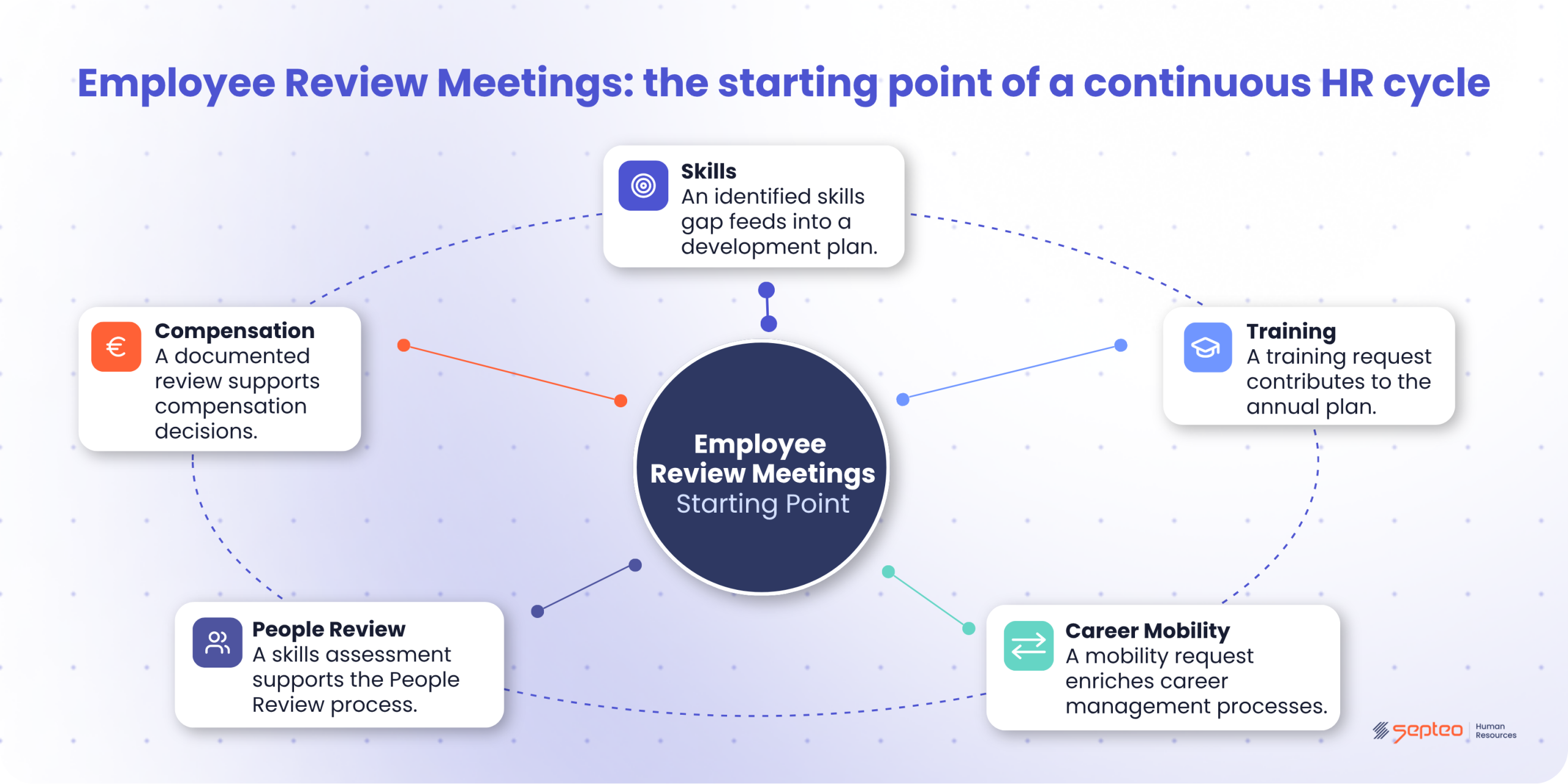
Employee review meetings become the starting point of a continuous HR cycle
A stand-alone tool helps complete a campaign. An integrated HRIS helps the organisation act on what the campaign reveals and review the impact at the next conversation.
- a skill need feeds into a development plan
- a learning request enters the learning process
- a mobility aspiration enriches career management
- a skills assessment informs a People Review
- increased responsibilities may inform a reward decision
- an agreed action returns in the employee’s follow-up
Employee review meetings therefore connect managerial dialogue with organisational decisions and bring continuity to the employee journey.
Ready to get more out of your performance reviews?
Discover our performance review management software, integrated into the mpleo HRIS.
Frequently asked questions about employee review meetings
Common formats include career development, annual performance, objective progress, mobility, onboarding, probation, return-to-work, workload, mid-career, late-career and exit conversations.
A performance review focuses mainly on work completed, results and objectives. A career development conversation focuses on skills, learning needs and future prospects. Keeping their purposes distinct generally makes both discussions clearer.
They can be scheduled close together, but their objectives and records should remain clearly distinguishable. Separate time slots often make the distinction easier for both parties.
Each decision should become an action with an owner, deadline and expected outcome. An integrated HRIS can connect actions with skills, learning, mobility and other HR processes.