
Training plan template
Why download this training plan template?
Many training managers start with a minimalist spreadsheet. At first, it seems sufficient. Then requests arrive by email, trade-offs multiply, mandatory training keeps recurring, postponements pile up and the budget becomes harder to track.
As a result, the training plan quickly becomes difficult to read, to defend and to manage.
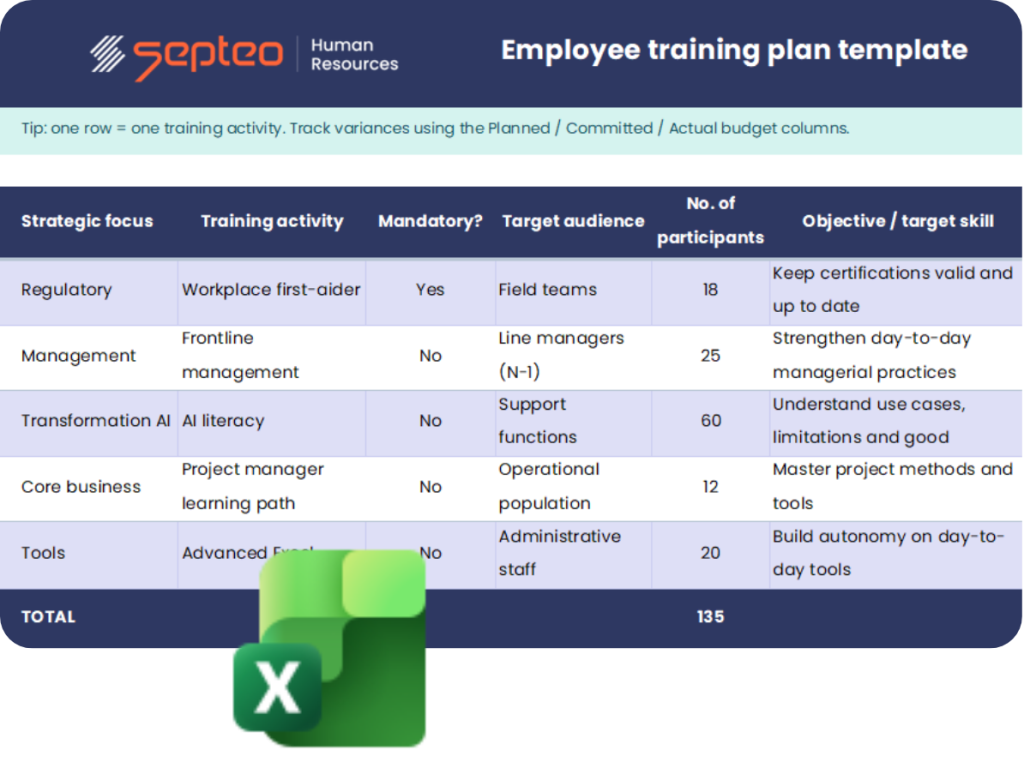
This is precisely why we designed this training plan template: a clear, ready-to-use foundation that helps you organise your actions better and stay in control.
Legal obligations: what your training plan template must include
France: documenting training actions and securing career paths
In France, employers are required to ensure that employees are able to adapt to their jobs and to maintain their employability. Training costs incurred under the skills development plan remain the employer’s responsibility.
In addition, in companies with at least 50 employees, a corrective top-up of €3,000 to the employee’s CPF (personal training account) may apply if, over the past eight years, the employee has not benefited from the required interviews and at least one non-mandatory training action.
In practice, this means that a useful training plan template must help you keep clear evidence: planned action, completed action, date, target audience, supporting document, decision rationale and change history.
Belgium: formalising an annual plan and maintaining a usable overview
In Belgium, companies with at least 20 employees must draw up an annual training plan by 31 March each year.
There is no mandatory template, but the plan must, at a minimum, include both formal and informal training. It must also be made available to employees and their representatives upon request.
How to fill in the training plan template
Step 1: define your strategic priorities
Before filling in your table, start by structuring the plan around 4 to 8 simple strategic focus areas: regulatory compliance, safety, management, job-specific skills, digital transformation, AI, tools, customer relations, etc.
This is what then allows you to prioritise requests, allocate budgets and produce readable analyses.
Step 2: centralise needs collection
Collection is one of the first sticking points for training managers. When needs come in through emails, separate Excel files, interview reports and informal requests, the plan quickly loses coherence.
Your training plan template should therefore include a dedicated column for the source of the need:
- interview
- manager request
- strategic need
- regulatory obligation
- ad hoc request
This allows you to distinguish what belongs to the initial plan from what is added during the year.
Step 3: make trade-offs using visible criteria
Good decision-making does not rely on intuition alone. It relies on transparent criteria:
- urgency
- mandatory or not
- business impact
- population concerned
- alignment with development priorities
- cost
This is the stage where a well-structured training plan template makes all the difference. It avoids overly subjective decisions and enables the HR department to justify a refusal, a postponement or a prioritisation.
Step 4: build a defensible budget
This is often where the table becomes truly useful.
Do not settle for a single amount. Plan for three levels:
- Planned budget: what was approved in the initial plan.
- Committed budget: what you will actually spend once registrations, quotes, orders or bookings have been made.
- Actual budget: what has actually been invoiced or paid, including incidental costs.
A training manager must not only be able to explain how much was planned, but also justify the gap between the plan, the commitments and reality.
Step 5: manage the training plan throughout the year
A training plan is not a static document. It evolves throughout the year.
You therefore need to be able to track:
- new requests
- cancellations
- postponements
- changes of provider
- cost variations
- mandatory training to be rescheduled
- immediate and delayed evaluations
This is why a simple Excel file can quickly become insufficient.
Key takeaway: a good training plan template is not only there to meet an obligation or present a budget. It helps you make better decisions, prioritise the right actions, secure mandatory training and manage training spend without losing track of trade-offs.
In other words, the right template is not simply one you can copy and paste. It is one you can keep alive.
And this is exactly where digitalisation makes the difference. When your training plan still depends on several files, scattered emails and budget tracking rebuilt by hand, the issue is no longer just the template. The issue is the tooling. With training management software such as mpleo, you can centralise needs, structure your trade-offs, track costs at the right level of detail and keep a training plan that can be managed throughout the year.